
This article is based on content originally published on our partner platform Seerist, the augmented analytics solution for threat and risk intelligence professionals.
In January 2025, US President Donald Trump issued Executive Order 14157, describing organised criminal groups (OCGs) in Latin America and the Caribbean as a “national-security threat” and designating some of them as foreign terrorist organisations (FTOs). The designation significantly increased compliance, legal and reputational risks for companies and investors.
Under US law, providing “material support or resources” to an FTO became a criminal offence. A link to an FTO anywhere in a company’s operations, supply chain or third-party relationships could suddenly trigger severe financial penalties and prison sentences of up to 20 years for executives. This is not a step change in enforcement. It is a state change in liability.
Donroe Doctrine
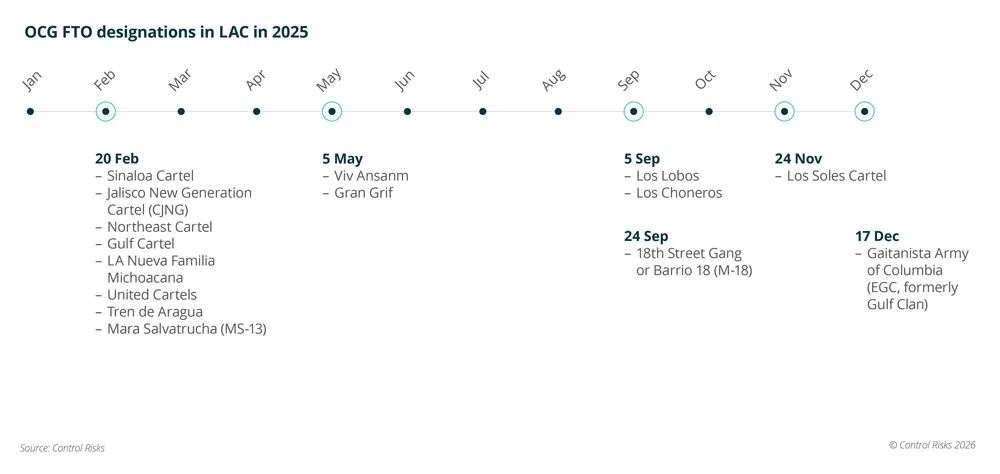
The issue of drug cartels resonates with Trump’s base and, as a result, we can expect further developments and declarations ahead of the US mid-term elections in November. Trump’s emphasis on OCGs will also serve as leverage against Mexico when the US-Mexico-Canada trade agreement (USMCA) review begins in July. This approach won’t be confined to the US–Mexico relationship. The designation of the Los Soles Cartel, the second Venezuelan group added to the FTO list, formed part of a broader escalation of diplomatic, economic and military pressure on former president Nicolás Maduro ahead of his capture on 3 January.
Mexico first
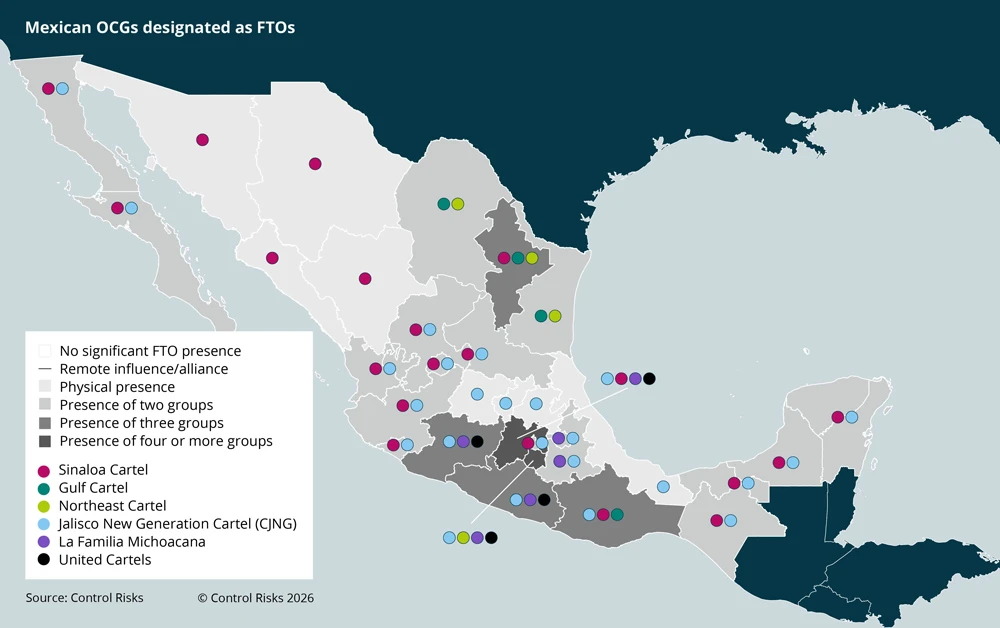
Mexico has been the principal focus of FTO-related discussions, investigations and indictments, reflecting Mexico’s centrality to several Trump administration security policy priorities and the scale of US corporate and investor exposure in the country.
Enforcement has not come solely from the US and will at times be administrative or regulatory rather than prosecutorial. For example, after the Treasury Department’s Financial Crimes Enforcement Network identified three Mexican financial services institutions as having links to OCGs, the government intervened to strengthen their Anti-Money Laundering/ Counter-Terrorist Financing (AML/CFT) controls.
Mexico will remain under the microscope in 2026 amid an evolving organised crime landscape, the anticipated inclusion of the Juárez, Tijuana and Santa Rosa de Lima cartels to the FTO list, the FIFA World Cup, the USMCA review and the US mid-terms.
Widening the lens
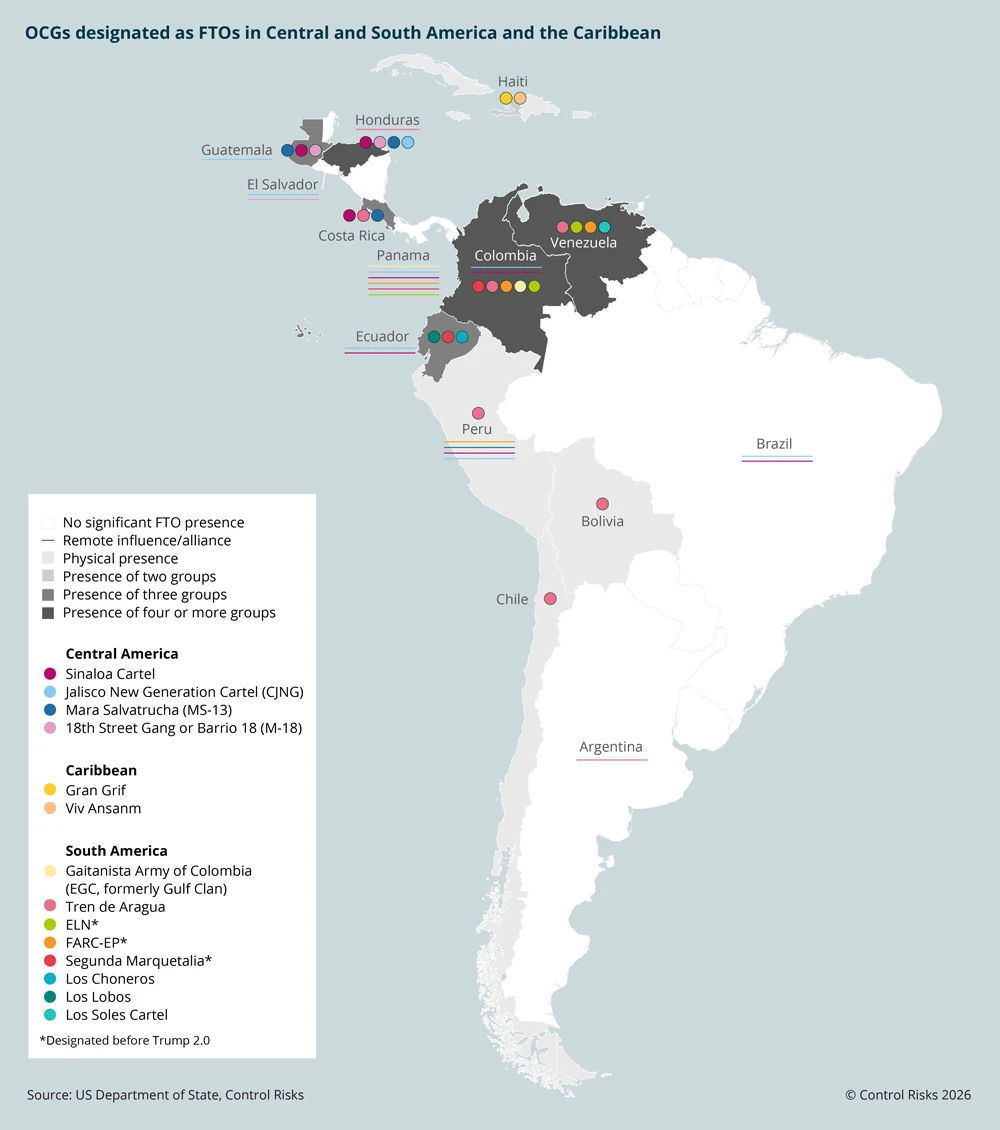
2026 will see increased FTO scrutiny across other parts of the region. As in Mexico, OCGs across Central and South America, as well as the Caribbean, are growing in strength and sophistication – and increasingly overlapping with the operations of formal companies and other organisations. Since February 2025, the US has added a further seven OCGs to the list, including groups in Haiti, Ecuador and Colombia.
Other than Mexico, Colombia will likely face the most intense FTO attention this year, particularly ahead of the presidential election in May.
Two groups conspicuous by their absence from the FTO list are the Brazil-based First Capital Command (PCC) and Red Command (CV), both of which have an extensive footprint across Brazil and the Southern Cone. Washington has explored FTO designations for both, but no formal process or timeline has been announced. The issue will become increasingly politicised ahead of Brazil’s general election in October, with opposition politicians already calling for these groups to be designated as terrorist organisations. Whether politically motivated or not, these developments demonstrate that FTO oversight won’t just come from the US.
Field notes
Control Risks has supported several clients with FTO-related investigations and organised crime-focused risk assessments. These are our three key takeaways:
1. Companies’ exposure is considerable and growing:
- The geographical reach of FTO-designated OCGs at the national and regional level is extensive.
- OCGs are involved in an expanding array of illicit activities and nominally “legitimate” enterprises, with increasingly sophisticated modi operandi.
- Few, if any, sectors are immune to the malign influence of organised crime. Our work has covered agriculture, energy (power and oil and gas), food processing, manufacturing, mining and travel services.
2. Exposure can manifest itself in several ways. It can be:
- Direct, most notably through extortion and other off-the-books payments to OCGs.
- Indirect or unintentional, for example where a third party is subject to extortion demands, or a service provider (such as a law firm, “union” or supplier) is owned by, or linked to, an OCG.
- Related to intermediaries – known colloquially in Mexico as gestores – a catch-all term that should set alarm bells ringing whenever it’s mentioned.
3. FTO-related risks can be planned for and mitigated against by:
- Proactively mapping and monitoring organised crime dynamics.
- Conducting robust due diligence and stress-testing AML/CFT controls and protocols.
- Vetting third parties and training staff to identify red flags.
Passive risk management, reactive compliance and deliberate ignorance are no longer an option – if they ever were.